
Call Center Improves Office IAQ and Reduces Maintenance Through Ultraviolet-C Technology
North Carolina, USA
Download Case Study PDF- $450K
- Remediation investment protected
- 0
- Mold recurrence
- 90%+
- Microbial kill rate
- 5
- AHUs treated
The Challenge
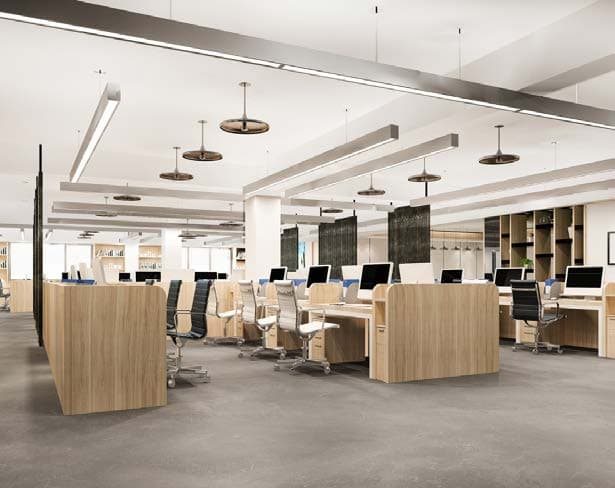
Ever since chief building engineer Rick Hansen assumed responsibility for a three-story 200,000-square-foot North Carolina office complex, he worked to resolve longstanding tenant complaints of dusty HVAC vents. The single-tenant Class A building housed roughly 650 call center employees who routinely asked maintenance teams to clean dust and debris from the tops of desks, bookcases, cubicle walls and carpet spaces directly under HVAC supply diffusers. Hansen discovered the "dust-up" had occurred for several years, but was especially prevalent during high heat loads — approximately nine months out of the year — when higher air volumes would expel handfuls of dust particles. Upon discovering traces of mold in independent lab samples, Hansen convinced building ownership to disinfect the building's entire HVAC system. The extensive four-month remediation project — estimated at $450,000 — painstakingly cleaned and sanitized all mechanical systems and ductwork across roughly 250 variable air volume terminals, conducted entirely at night and over weekends to avoid disrupting operations. The challenge: after spending nearly half a million dollars, how do you ensure biological growth never returns?
“By installing the UV-C germicidal fixtures, we're saving future dollars that inevitably would need to be spent again in another 7-10 years to sanitize the AHUs and ducts.”
The Solution
To prevent organic growth from returning in each of the building's five York variable-volume air handlers (35,000–55,000 CFM), UV-C germicidal systems were installed. The 253.7 nm germicidal C-band wavelength inactivates virtually all microorganisms living on HVAC surfaces with a kill ratio of 90 percent or higher, depending on UV-C intensity and the length of exposure. Unlike pressure-washing or chemical cleaning, UV-C reaches organic growth lodged deep within the 18-inch thick chilled water coils — irradiating systems continuously 24/7/365 without chemicals, labor, or service interruption. "After 20 years of running 55-degree saturated air nonstop throughout the building, it became apparent that the source of the HVAC dust began with organic growth proliferating from the cooling coils," explains the specifying contractor. "Once the coils were mechanically cleaned, UV-C germicidal energy would stop and prevent microbial growth in the HVAC system, and would provide the extra benefit of improving cooling capacity and heat transfer efficiency."
Results
Following the installation of the germicidal lamps, Hansen's team saw a drastic decrease in HVAC dust and accompanying maintenance calls. "For roughly a month after the UV-C fixtures were installed, nearly all of our AHU condensate drains were filled with tan-colored, leathery shreds of 'bacon-like' material," recalled Hansen — organic biofilm left deep in the cooling coil that mechanical cleaning had missed, now being purged by the UV-C. Even the thickest, impacted coil buildup is no match for the killing power of the UV-C germicidal wavelength, irradiating HVAC components continuously 24/7/365. "By installing the UV-C germicidal fixtures, we're saving future dollars that inevitably would need to be spent again in another 7–10 years to sanitize the AHUs and ducts," said Hansen. Based on these results, Hansen extended the facility's service agreement to include an annual inspection and re-lamping maintenance program. The property management firm subsequently evaluated similar retrofits for eight other office buildings it manages in North Carolina.
- $450K
- Remediation investment protected
- 0
- Mold recurrence
- 90%+
- Microbial kill rate
- 5
- AHUs treated
- 24/7/365
- Continuous sanitization
Your facility could be next.